
Welcome to
Bideltavanes.com
Shown with applied
Bi-Delta VANE STAIN™
in
Flo Lime halo.
Home - Contents - News - Vane
Models - How To - Order -
Help - Search
|
Vane Stain™
|
The Best Way To Fletch Vanes &
AVLM
AVLM (Actual Vane Length
Mass)
4" Hunter
3-D/10grs
3.4"
4" Rain Vane Feather-Like™/10grs
3.4"
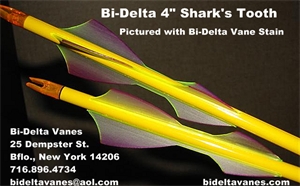
4" Shark's
Tooth™/9grs
3.4"
4" Jet
35™/7.5grs
3.3"
3" Hyper
Delta™/5grs
1.5"
2.5" Shark's
Tooth™/4.5grs
1.9"
BBW -
Broadhead Blade Width should never exceed the width
of your fletched vanes.

The following instructions will give you the professional skills needed to properly fletch arrow shafts. WARNING ! Any modifications in the steps, products or timing may result in fletching adhesion failure.
Before we begin, one fact that everyone has to understand, ALL shaft and vane materials along with the finished product are handled many times before you receive them. The worker's hands maybe contaminated with hand cream, residue from lunch or tools. Also remember to be safe when fletching. Have the work area ventilated. And above all, USE AN ORGANIC VAPOR MASK !
Notice, the water beaded up. That area is contaminated.
2. Cut a piece of an old clean towel. Make sure the towel has not been contaminated with fabric softener or perfumed soap. Wet the piece of towel and sprinkle on some Bon Ami cleanser. Ajax will work in a pinch.
3. Scrub three shafts and rinse them under very warm water. Look at the area. The water " sheets " around the shaft. That area has been de-contaminated. DO NOT wipe them dry! Shake the water off and let them air dry on a table with the fletch-end overhanging the table's edge. If these shafts get licked by the dog or touched by the kids, you have to do this step over again.
4. After the shafts have dried, place them in your fletching tool (s) and load the vane (s) in the clamp (s). Do you see any residue from the Bon Ami on the fletch area of the shaft (s) ? If you do, take a clean piece of a non-lint cloth or paper towel and dampen it with 91% ISOPROPYL ALCOHOL. DO NOT use rubbing alcohol of any kind. It has to much water and some contain oil. Wipe it off in ONE DIRECTION ONLY. If you wipe back in the other direction, you will be re-depositing the the material you are trying to get rid of. Also, wipe the glue channel of each vane with a clean piece of a non-lint cloth or paper towel in one direction only.
5. For this step, make sure to use reasonably fresh fletching adhesive. For carbon, I like Fletch-Tite Platinum and Fast Fletch. For aluminum and wood, I like standard Fletch-Tite, Bear-Tite, Saunders and so on. Timing is important here. Apply the adhesive to the vane's base, put the adhesive down and set the vane on the arrow shaft. DO NOT set the vane down with the cement on it's base and put the cap on the fletching cement and then apply the vane to the arrow shaft. If you do that, or have been, your allowing the cement to "skin". That means the surface of the cement is starting to dry. When a vane comes off, this is one of the reasons why you see most of the cement on the vane and hardly any on the shaft.
6. After your vanes have dried, take each arrow and apply a spot of cement to the tip of the vane and the rear of the vane. This gives the vane added adhesion when dealing with a pass through and shooting tight groups.
bideltavanes(at)aol.com
Phone - 716-896-4734,
9am - 5pm M-S
Fax - Receives after 4th ring.
International - 0101-716-896-4734
Bi-Delta® Vane Systems
25 Dempster St.
Bflo., N.Y. 14206-1307
Home -
Contents - News - Vane
Models - How To - Help - Search
- Order
|
|